Wednesday, September 10, 2025

Orchids in Procreate – Finding the Right Style


These orchid drawings have been living quietly on my iPad for longer than I’d like to admit. I started them last year after asking some of my orchid-gardening friends to send me photos of their favorite blooms. They came through with some incredible images—Cattleyas with frilly ruffled edges, graceful sprays of Cymbidiums, and delicate Phalaenopsis stems with that signature arch.


When I first began sketching them out in Procreate, I approached the project the same way I often do with botanical drawings: careful outlines, expecting to slowly layer in color, shading, and detail. My original plan was to build them up into more traditional, dimensional renderings—something lush and realistic.


But somewhere in the process, I realized the outlines themselves had a strength of their own. The bold line work gave the orchids a graphic presence, almost poster-like, that didn’t need layers of painterly shading to feel complete. I tried adding flat blocks of color instead, and suddenly the pieces clicked into place. The flat graphic style gave them a sense of immediacy and freshness that matched the unique character of each bloom.


The Cattleya with its yellow ruffled flowers became almost architectural, standing out with stark contrasts against a clean background. The Cymbidiums translated beautifully into a cascade of simple shapes, their repeating forms flowing in rhythm down the page. And the Phalaenopsis, with just two blossoms on an arched stem, felt both minimal and expressive at the same time.


What surprised me most was how much the “unfinished” quality of the outlines ended up being the finished work. Sometimes I go into a piece with a clear plan of where I want it to go, but the process insists otherwise. In this case, the orchids didn’t want to be painterly studies. They wanted to stay bold, flat, and graphic, with clean color fields and crisp edges.


Looking back, I think that’s one of the joys of working digitally—having the freedom to experiment without the pressure of wasting materials, and discovering along the way that the drawing itself already had everything it needed. These orchids taught me to trust the line and let simplicity speak.


I’ll probably continue experimenting with them, maybe even revisiting the idea of shading and depth in the future. But for now, I like them best in this form: simple, striking, and a little unexpected.


—Richard


Thursday, June 19, 2025

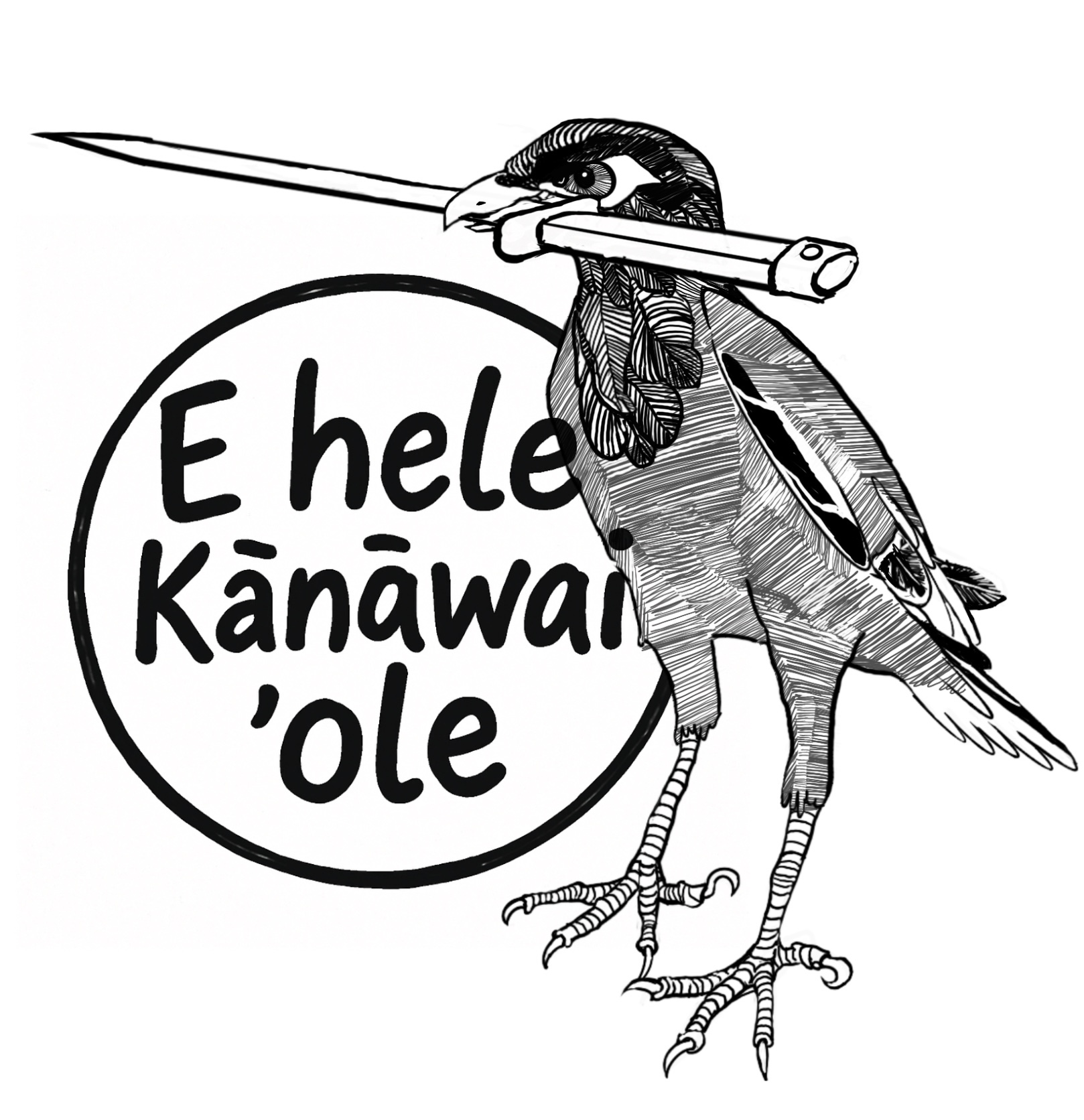
E hele Kānāwai ‘ole – The Ungovernable Mynah

This piece started as a riff on the “become ungovernable” meme— from the Untitled Goose Game, where the goose is wielding a kitchen knife in pure chaotic defiance. I thought it would be fun to localize that idea. Instead of a goose, I drew a mynah bird—one of the loudest, most opinionated, and most common birds in Hawai’i.

The phrase I paired with it is “E hele Kānāwai ‘ole.” It’s a Hawaiian phrase that literally translates to “go without law” or “step without rules.” It carries a much more poetic and playful tone than the way Google Translate butchers it into “to become illegal.” That translation totally misses the spirit—this is more about defiance and playfulness.

I chose the mynah bird specifically because they’re such characters. You see them everywhere in Hawai‘i—strutting, squawking, always up to something. They’re smart, scrappy, and fearless. I once watched a pair of them go after a mongoose. One kept its attention while the other dive-bombed it—like some kind of avian tag-team. I wanted that attitude to come through in the drawing.

I created the image in Procreate, focusing on tight linework and dense crosshatching. I love that optical buzz that happens when you do detailed hatching digitally—it’s one of the few things in digital media that still gives me that tactile satisfaction. For now, it’s black and white, but I might color it if I decide to make stickers out of it. Depends on how I feel.

Monday, June 9, 2025

Downtown Art Center Honolulu Monday Figure Drawing 06/02/2025 Alicia – Structure, Process, and “The Matrix”

These two drawings are from this week’s figure drawing session at the Downtown Art Center. Both are 20-minute poses, done in ink and finished with watercolor. Alicia modeled for us—she brought great energy and poise, she is always such a good model. 

I was feeling particularly structural in my approach that night. I found myself going back through anatomy in my head, laying things out almost like blueprints. The final results felt pretty mannered and almost comic book–like—not in a bad way, but definitely stylized. That kind of draftsmanship muscle memory takes over sometimes, especially in short poses where you don’t have time to second guess.

In the second drawing, I think you can see my current process more clearly: I lay in counter lines to define the forms, and then slowly build mass with crosshatching. There’s a rhythm to it that I find really satisfying, even if it does tether me a bit too tightly to outlines.

After the second pose, Ellen passed by and looked over my shoulder. “Ooh—the Matrix,” she said. I laughed, because it kind of fits. The scaffolding, the visual structure, the way the drawing builds itself from a digital-looking skeleton outward—it’s all in there.

I’ll admit I felt a little frustrated with how dependent I am on outlines right now. But with 20-minute poses, there’s only so much freedom you can give yourself. It’s a tradeoff between instinct and observation. And maybe that’s the beauty of figure drawing—it forces you to sit in that tension and keep going.

If you want to join in, we meet every Monday at 6pm at the Downtown Art Center. It’s open to everyone. Come draw with us.

Wednesday, November 17, 2021

Day Twelve: 'Ohi'a


Pencil Drawing: 'Ohi'a

In Hawaiian mythology, handsome 'Ohi'a, in love with beautiful Lehua, rejected  Pele who loved him, too. Enraged, the jealous volcano goddess turned 'Ohi'a into a tree. Other gods transformed the heartbroken Lehua into the flower of the 'Ohi'a tree. On the day you pick the lehua blossom, you are separating the lovers and it will rain.

Folklore aside, the 'Ohi'a Lehua plant was important to early Hawaiians. The wood created weapons, leaves made a medicinal drink, and the seeds fed native birds.

Today,  the hearty ʻŌhia rises from lava rock and blooms at Hawaiʻi Volcanoes National Park. Hula dancers wear lehua blossoms in lei headbands, around wrists and ankles. 'Ohi'a branches create traditional kalaau, or dancing sticks.

Monday, November 15, 2021

Day Eleven: Kokiʻo keʻokeʻo


Pencil drawing, Kokiʻo keʻokeʻo

"Kokiʻo keʻokeʻo (Hibiscus waimeae) has two subspecies. The subspecies hannerae is federally listed as an endangered species. It is distinguished by the much larger leaves and smaller flowers than appear in subspecies waimeae." Source: Native Plants Hawaii website.


Oh, Rare Hibiscus

Beautiful Kokiʻo keʻokeʻo
as white as the whitest sunshine
your red heart, the heart of the sun
in Molokaʻi, in my beloved Ko'olau forest.

You alone, oh rare hibiscus!
your sweet strength, this fragrance
opening for me in the morning
closing for me at night.

Heaven on earth:
Hana Mana, Kokiʻo keʻokeʻo.

@mscator, 11.15.21

Sunday, November 14, 2021

Day Ten: `Awa


Pencil drawing, `Awa


Early Polynesian voyagers brought the `Awa ("bitterness") plant to Hawaii and it grows abundantly in my hometown of Kaneohe, Windward Oahu, and other moist lower areas on all the islands. Called Kava or Kava Kava throughout the Pacific Islands, `Awa can be made into an herbal remedy that helps anxiety, insomnia, and other ailments.

`Awa was important to the ceremonies and cleansing rituals of Ancient Hawaiians. A favorite offering to the gods, chants recall how the gods Käne, Pele, and Kanaloa, were famous `Awa drinkers. 

Missionaries who came to Hawaii in 1820 discouraged the use of the intoxicating plant, but in recent years interest in the historical, cultural, and alternate medicine aspects of `Awa has resurged.

Friday, November 12, 2021

Day Nine: Kiawe


Pencil drawing, Kiawe

The first Kiawe wood seedling was planted in 1827 by Sacred Hearts Father Alexis Bachelot next to the Cathedral Catholic Church in downtown Honolulu's Fort Street Mall. Legend is he brought the tree from Chile.

With a large trunk and gnarly branches, Kiawe is a mesquite tree of hard, long-burning wood used for smoking meats and BBQs. Most importantly, Kiawe works great slow-cooking kalua pig in the imu.

Wednesday, November 10, 2021

Day Eight: Two Milo Seeds


Pencil Drawing: Milo Seed Pods

The Milo is an interesting tree, its botanical name, Thespesia populnea, means “divine." A member of the hibiscus family, the bell-shaped Milo flower is pale yellow with a maroon center that blooms for just one day, then closes and becomes a seed pod as shown in this drawing. 

The pods dry brittle into papery capsules, opening at maturity, releasing about seven seeds that grow quickly and easily. Lamp oil has been made from the seeds.

The tree thrives on sandy coastal and volcanic soils and has a curved trunk and a large 30-foot spread that creates shade, windbreak, and shelter.

Ancient Hawaiians carved the beautiful dark heartwood of the Milo tree into canoes, food bowls, poi calabashes, platters and dishes, tools, and utensils. Milo wood remains easy to work with, has a smooth natural finish, and is durable.

Tuesday, November 9, 2021

Day Seven: Laua‘e

Pencil drawing, Laua‘e Fern

Common Is Uncommon

From Oceania to green Hanalei
the common Laua‘e fern
transformed to pe‘ahi of legend
our halau bends
to gather this spirit
for our hula kuahu and lei
as fragrant as sweet maile
kissing ankles, wrists, heads.

Joyous Laua‘e fingers
understand the dance:
ka makani, ka la, ua.
life, moon, aloha

For you, Beloved,
Common is Uncommon.

Together, we perform
this timeless ritual:

Our Chant--
sky and earth
heart to heart.

 @mscator 11.9.21

Monday, November 8, 2021

Day Six: Koa "Leaves"


Pencil drawing, Koa "Leaves"

"To be a warrior is to learn to be genuine in every moment of your life."
Chogyam Trungpa

Imagine this-- the Koa tree only grows in Hawaii and Koa wood is the most beautiful wood in the world. "Koa" means fearless, warrior, brave, like King Kamehameha the Great who unified the Hawaiian Islands with swords, canoes, and paddles created with Koa.

Koa is revered, the wood of Hawaii's birth and history. Inside Iolani Palace, the home of the Hawaiian monarchy, the Grand Hall staircase is made of Koa.Duke Kahanamoku rode the Waikiki waves with his 114-pound Koa surfboard.

Today, musicians know that a ukulele or guitar made of Koa will have tonal magic. The wood grain of Koa is exquisite and expensive. And unique. Whether furniture, crafts, carvings, or jewelry each piece is different in color and grain.

Sunday, November 7, 2021

Day Five: Mushrooms Growing on a Ti Stalk


Pencil drawing, Mushrooms Growing on a ti stalk


Living

This life
it takes all
that you have.

And what do you give it?
Everything.

@mscator 11.7.21

Saturday, November 6, 2021

Day Four: The Uluhe Fern


Pencil drawing, Uluhe


Precious Uluhe

Hawaii's uluhe fern,
righteous protector of Pele's rainforest,
Growing steady in Laupahoehoe.

Coiled frond, an energy swirl
shooting, reaching upwards
climbing
holding, hugging, caressing
soil and sky.

Independent Uluhe, 
Thick blanket for pali and aina
Healing aloha,
roots deep, trailing
wild in the cool rain.

Precious Uluhe,
adventurous
harvester of tomorrow.

@mscator 11.6.21

Friday, November 5, 2021

Day Three: Kukui Nut

Pencil drawing, Kukui Nuts


When my Dad travels to the Mainland, representing Hawaii's Veterans of Foreign Wars (VFW), he brings a kukui nut lei for the people he meets with as a token of aloha.

This is just one of many usages of the versatile Kukui, which means "candlenut" in English and is the state tree of Hawaii. Called the "Tree of Light," the oil of the kukui nut kernel has a high oil content that is highly flammable and is a natural source of light when lit.

Planted in gardens as a shade tree, the silvery-green leaves of the kukui flourish in the Hawaiian sunlight.

"Art is not to throw light but to be light."
Kenneth Patchen

Thursday, November 4, 2021

Day 2: Dry Hau Flowers


Pencil drawing, Dry Hau Flowers

The hau is a very special tree. Native to Hawaii and a member of the hibiscus family, hau spreads throughout the islands as a prolific shrub or wild and protective coastal bush. Hau is tough and resilient.

Historians say the hau seeds and cuttings were carried in canoes to Hawaii in ancient times. The naturally-curved, pliable branches of the hau softwood were used to make the vital canoe outriggers for transportation, exploration, connection to nature, and so much more.

Amazingly, the plant is also resistant to salt. Hawaiians transformed the hau bark into thick rope for strong nets which held strong in the ocean water. Net fishing, from shore or canoe, is the heartbeat and strength of our island heritage.

The hau flower is a sacred miracle, a spark of life, and a symbol of the human spirit. Its life tells us the story of our fragile, brief lives. With heart-shaped leaves, the five-petal hau blossom unfurls a yellow color at first light, turns orange in the afternoon, and dies dark orange by moonlight.

"From sun up to sun down."
 (mai ka la hiki a ka la kau.)

Hawaiian Proverb

Wednesday, November 3, 2021

Day One: Kualoa from Waiahole


Pencil drawing, Kualoa from Waiahole

I have a new project-- I will be creating a pencil drawing a day. 

Let's start with a drive to the small community of Waiahole, located on Oahu's windward coast. Green Waiahole Valley is rich in Hawaiian history, with fertile land, watered by the heavens, and where taro, the staple food, flourished and nourished. 

From Waiahole, I sketched this view of beautiful Kualoa ("longback"),  which is kissed by the area's rich Ka'a'awa Valley, sacred burial caves, cattle ranch, and soaring Koʻolau Mountain Range

With such breathtaking vistas to soak in, it is no wonder that dozens of Hollywood films have been filmed here. I explored the area extensively during my boy scout days, and remember the rich Hawaiian folklore and maybe even heard the drumbeats of the night marchers on full moon nights. 

"Drawing is not what you see but what you must make others see."
 Edgar Degas

Wednesday, April 12, 2017

Triumph - Day 1

Day 1, Oil on Linen, 72"x 96". 2017 
The final push of school is getting palpable. I am really happy to get started on this large painting.

Today was our final group critique with my thesis advisor Peter Drake. It was a lot of fun. I am really happy with the amount of work I've been able to get done.